Why LED Walls for Automotive Virtual Production are Essential
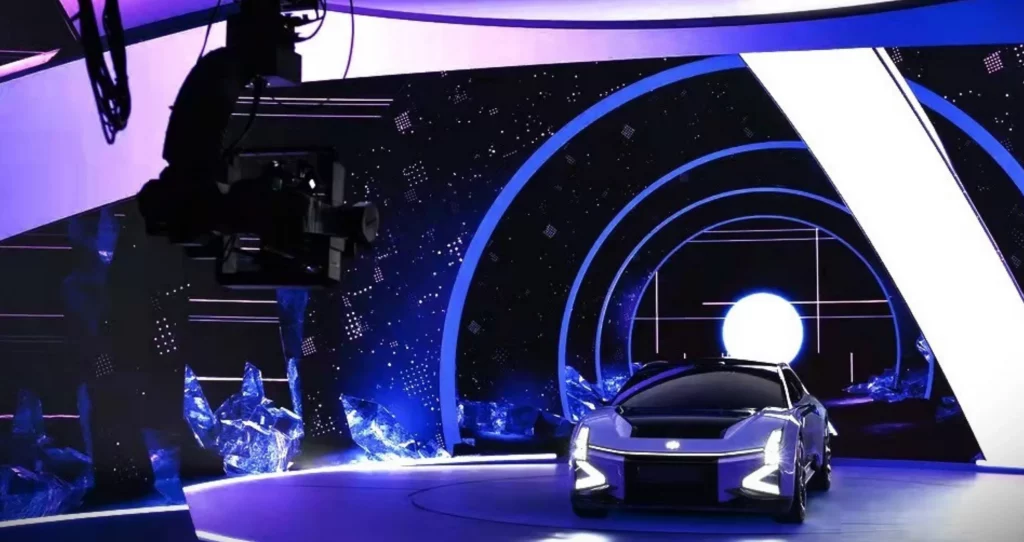
In the history of automotive advertising, the “hero shot” has traditionally been defined by logistics. To capture a luxury vehicle against a perfect desert sunset or a rain-slicked neon city, production teams spent millions on location permits, car carriers, and the unpredictable whims of weather. Today, that paradigm has shifted. The most iconic car commercials and global vehicle launches are no longer happening on the road—they are happening inside a volume.
The rise of LED Walls for Automotive Virtual Production has fundamentally changed how we perceive motion and light. For an automotive brand, a car is not just a product; it is a mirror on wheels. Capturing the “soul” of a vehicle requires absolute control over every reflection, every glint of chrome, and every curve of the chassis. At HOLODECK LED™, we have engineered the specific canvases required to meet these extreme optical demands, most notably evidenced in our work at Saibo Studios.
Why Automotive Shoots are Different
Filming a human actor in a Virtual Production (VP) volume is a matter of color and perspective. Filming a car, however, is a matter of physics. Because modern vehicles feature highly reflective surfaces—from metallic paint to curved glass—the LED wall does not just function as a background; it becomes the primary light source and the primary reflection.
When utilizing LED Walls for Automotive Virtual Production, cinematographers face the “reflection gap” challenge. On a standard flat screen, reflections on a car door appear segmented or “stepped.” To create the illusion of a car moving through a real-world environment, the light must wrap around the vehicle in a continuous, fluid motion. This is why the architecture of the volume—incorporating curved walls and digital ceilings—is the deciding factor in the quality of the final shot.
Saibo Studios: A Case Study in Automotive Digital Media
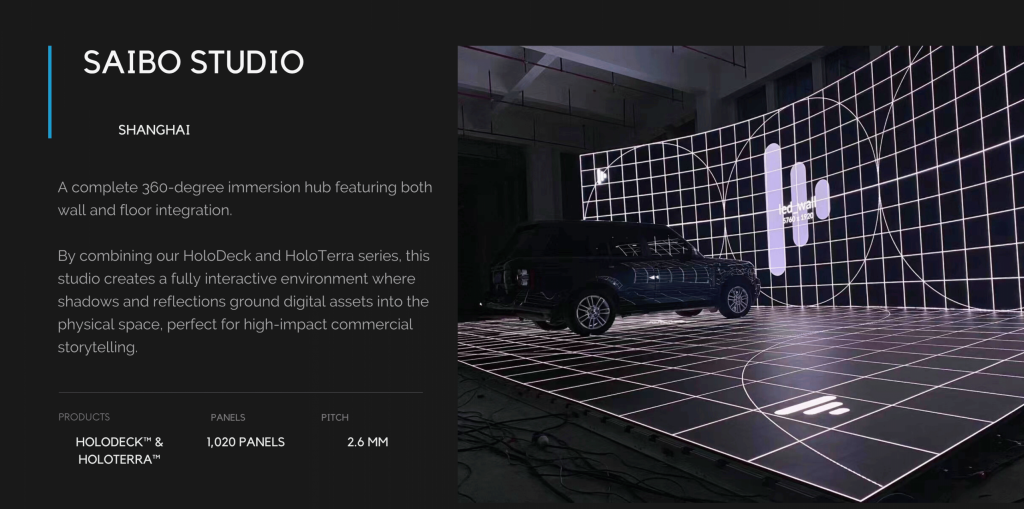
Located at the forefront of the immersive tech revolution, Saibo Studios serves as a premier example of how specialized hardware can redefine automotive storytelling. This project was engineered specifically to handle the “reflection management” required for high-end vehicle media.
1. The Power of the Curve
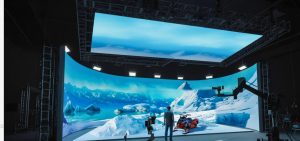
The Saibo installation utilizes a massive curved array featuring over 1,040 HOLODECK™ panels. By employing a precision-curved structure, the studio eliminates the harsh angles that would traditionally break a reflection on a car’s hood or side panels. This creates a perfectly controlled lighting environment where “digital horizons” can be manipulated with millimetric precision.
2. The 2.6mm “Golden Ratio”
For automotive work, the pixel pitch is a critical variable. Saibo Studios utilizes a 2.6mm VP Grade pitch. This provides a high enough resolution to ensure that even in tight close-ups of a car’s headlight or interior dashboard, the “screen door effect” remains invisible to the camera. More importantly, the 2.6mm pitch offers the brightness required to simulate high-noon sun or the intense glare of city streetlights.
3. Total Immersion: Integrating the HoloFloor™
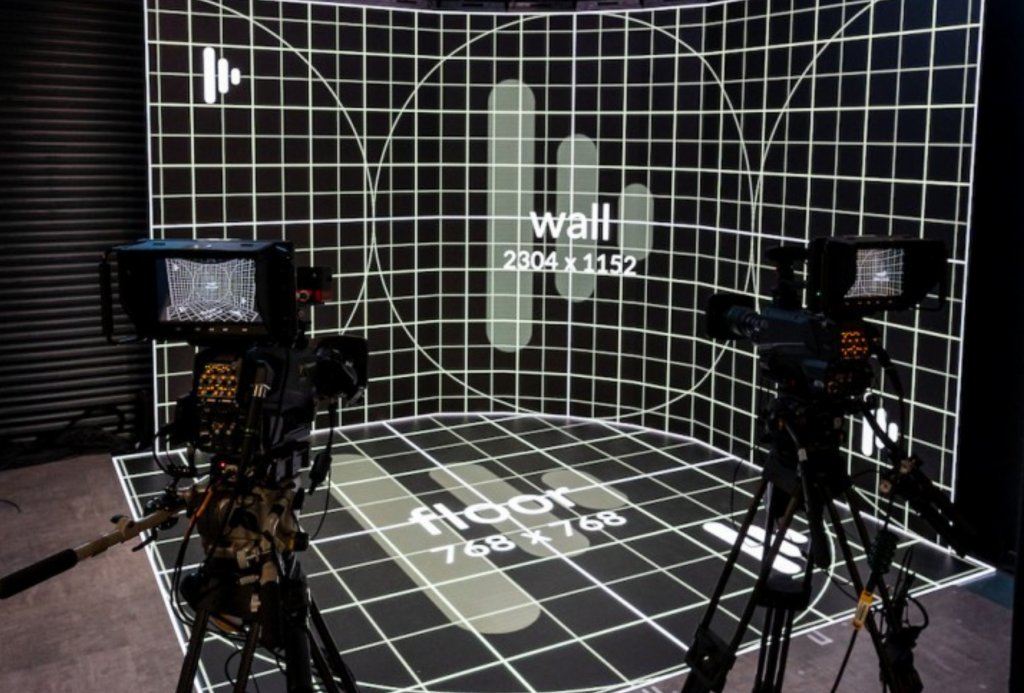
Automotive virtual production is incomplete without the ground plane. At Saibo Studios, the integration of HoloFloor™ (HoloTerra) technology allows the vehicle to be “grounded” in the digital space. When a car sits on an LED floor, the undercarriage reflections and the shadows on the pavement match the digital environment on the walls. This creates a 360-degree immersion hub where the car, the ground, and the sky all speak the same visual language.
REDEFINE YOUR BRAND’S MOTION
Are you ready to move your automotive production into a world of absolute environmental control?
HOLODECK LED™ provides the engineering expertise to build custom volumes that eliminate reflections and maximize impact.
Explore Our Automotive LED Solutions
Why HoloDeck Virtual Production™ Panel is the Standard
To understand the success of LED Walls for Automotive Virtual Production, we must look at the technical specifications that allow these screens to perform under the scrutiny of 8K cinema cameras. According to industry insights from British Cinematographer, the primary failure points in LED volumes are color “banding” and flickering.
16-Bit Grayscale and Deep Black Levels
Cars are defined by their highlights and their shadows. If an LED wall cannot produce a true black, the “reflections” on a black car will look milky or grey, instantly breaking the illusion. Our HoloDeck VP™ series utilizes 16-bit grayscale to provide over 65,000 shades of color, ensuring that the transition from a bright sun-glare to a dark shadow on a car door is perfectly smooth and cinematic.
Refresh Rates and Scan Lines
Automotive commercials often involve high-speed camera movement and slow-motion shots. To avoid flicker, the LED Walls for Automotive Virtual Production must have a refresh rate that exceeds 15,360Hz. This ensures that even when filming at 240fps for a slow-motion “water splash” or “speed blur” shot, the LED background remains as stable as the physical world.
The Economic Impact: Why Virtual Production Wins
Beyond the visual “wow” factor, there is a massive financial incentive for brands to move toward LED Walls for Automotive Virtual Production.
-
The “Golden Hour” All Day: In a traditional shoot, you may only have 20 minutes of perfect “sunset” light. In a HOLODECK™ volume, you can freeze that sunset and shoot for 12 hours straight.
-
Eliminating Location Logistics: Shipping a prototype vehicle across the world is a security and financial nightmare. With a Virtual Production hub, the vehicle stays in a secure, climate-controlled studio while the “location” is brought to it via digital assets.
-
Rapid Prototyping: Automotive designers can now see their CAD models rendered in a “real” environment at 1:1 scale before a single physical car is even built.
Designing for “Final Pixel” Automotive Content
The ultimate goal of the “Creation” series is to achieve “Final Pixel” results. This means that when the director shouts “cut,” the footage is ready for the editor, with no need for expensive green-screen compositing or digital car-shaping in post-production.
To achieve this, HOLODECK LED™ utilizes the King-Pin Lock system. This mechanical precision ensures that there are no gaps between panels. Even a 0.1mm gap can cause a “dead pixel line” to appear in a car’s reflection, which would cost thousands to fix in post-production. By ensuring a mechanically perfect canvas, we save our clients time and money.
DRIVE THE FUTURE OF DIGITAL MEDIA
The era of the green-screen car shoot is over. Join the world’s leading automotive brands in the “Creation” realm. From curved arrays to immersive floors, we build the stages where dreams are rendered.
Consult with a HOLODECK LED™ Specialist Today
AI-Driven Environments and the 360° Showroom
As we look toward the next decade, LED Walls for Automotive Virtual Production will become even more integrated with AI and real-time ray-tracing. We are moving toward a future where “Virtual Showrooms” will allow customers to customize their cars in real-time on a 1:1 LED stage, seeing their specific paint and trim choices reflected in a digital version of their own city.
At HOLODECK LED™, we aren’t just building screens; we are building the infrastructure for this “phygital” future. Whether it is the 360-degree immersion of Saibo Studio or a bespoke car launch stage in Los Angeles, our technology ensures that the vehicle remains the star of the show.
Engineering the Reflection
The success of a car commercial rests on a single, flickering moment of light on a curved door. By mastering the engineering behind LED Walls for Automotive Virtual Production, HOLODECK LED™ has given automotive storytellers total control over that moment.
From the ultra-fine 2.6mm pitch of our “Creation” hubs to the massive curved scale of the Saibo Studios project, we have proven that the best way to capture a car is to build the world around it. The landmarks of tomorrow aren’t just on the skyline; they are inside the volumes where the most iconic brands in the world come to life.