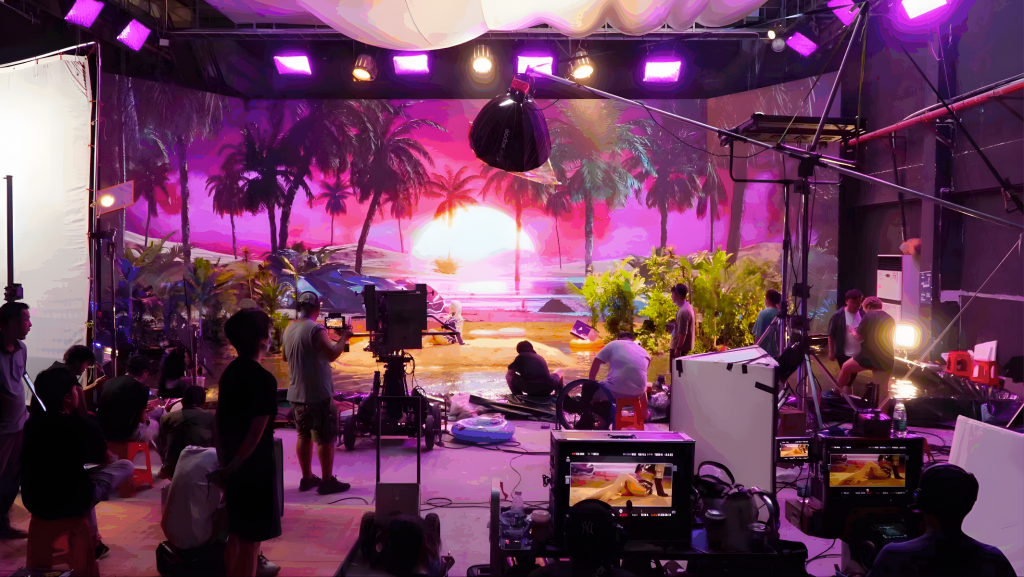
In the world of professional broadcast and cinema, the camera is the ultimate judge. You can build a breathtaking LED volume that looks perfect to the naked eye, but the moment the director looks through the viewfinder, a hidden world of technical “demons” can appear. Dark horizontal bands crawl up the screen, wavy rainbow patterns distort the background, and a subtle, nauseating flicker ruins the shot.
These artifacts—Scan Lines, Moiré, and Flicker—are the “Big Three” nightmares of In-Camera Visual Effects (ICVFX). They don’t just happen because of “bad luck”; they are the result of physics and a lack of synchronization between the display and the sensor. At HOLODECK LED™, we treat these challenges as engineering problems to be solved at the source.
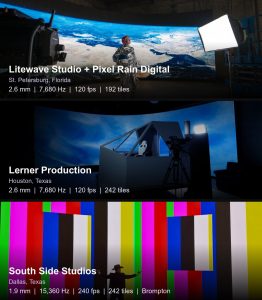
In this guide, we deconstruct the precision required for the “Final Pixel” and why the 15,360Hz refresh rate is the new global benchmark for professional studios.
Why 3,840Hz is No Longer Enough
The Refresh Rate is the number of times per second the LED display updates its image. To the human eye, anything over 60Hz looks like smooth motion. However, a cinema camera doesn’t see like a human; it samples the world in discrete “shutter” intervals.
The Math of the Flicker
If the camera’s shutter speed is faster than the LED’s refresh cycle, the camera captures the “dark period” between updates. This results in flicker.
-
The “Standard” Standard: Most high-end commercial screens offer 3,840Hz. For years, this was the gold standard.
-
The “Cinema” Standard: Modern virtual production often involves high-speed shooting for slow-motion 120fps or 240fps. At these speeds, 3,840Hz can fail.
Our HoloDeck Virtual Production™ series specifies a refresh rate of 15,360Hz. This ultra-high frequency ensures that the display updates several hundred times within a single camera frame, providing a rock-solid image that is indistinguishable from reality, even at 1/1000 shutter speeds.
Eliminating the “Scan Line” Crawl
Have you ever seen dark, moving bars on a screen when viewed through a phone or a camera? These are Scan Lines. They occur when the camera’s shutter “closes” while the LED’s driving ICs are in the middle of a scan cycle.
The “Creation” Solution: 1:1 Multiplexing
Traditional LED panels use “Multiplexing” (e.g., 1/32 scan) to reduce costs by sharing one driver chip across multiple rows of pixels. While efficient, this increases the risk of scan lines.
For our flagship Broadcast Studios, we prioritize low-scan or high-efficiency driving ICs that synchronize perfectly with the Genlock signal of the studio. This ensures that every row of pixels is “on” at the exact micro-millisecond the camera’s shutter is open, eliminating the “crawl” forever.
Defeating Moiré: The Battle of the Grids
The Moiré Effect is the most difficult artifact to solve. It appears as shimmering, wavy patterns (often with a rainbow tint) when the “grid” of the LED pixels interferes with the “grid” of the camera’s digital sensor.
The Physics of Moiré
Moiré occurs when the camera’s resolution is high enough to “see” the individual LEDs and the gaps between them.
To defeat Moiré without the use of expensive (and image-softening) optical filters, we utilize two strategies:
-
Fine Pixel Pitch: By moving to 1.2mm or 1.5mm pitches in the HoloGallery™ series, the pixels become so small that the camera sensor can no longer resolve the “grid,” even at close range.
-
Diffusion Coatings: Our GOB (Glue on Board) and specialized matte finishes act as a micro-diffusion layer, subtly “blurring” the gaps between pixels without losing the sharpness of the content itself.
ACTIVATE CAMERA-READY PRECISION
In the world of broadcast, you don’t get a second take on a live show. Ensure your studio is equipped with the 15,360Hz “Invisible Pixel” technology that directors demand.
Consult with a HOLODECK VP Specialist Today
Why “Genlock” is the Master Clock
In a Virtual Production Volume, the LED wall and the camera must speak the same language at the same time. This is called Genlock.
If the LED wall is running at 60Hz and the camera is running at 59.94fps, they will eventually drift out of sync, leading to a “tearing” effect or a momentary black flash. HOLODECK LED™ systems are engineered to receive an external Tri-Level Sync or Genlock signal directly into the processing hardware (like Brompton or Megapixel). This locks the “Heartbeat” of the screen to the “Heartbeat” of the camera, ensuring 100% visual continuity.
“Precision isn’t about the pixels you see; it’s about the artifacts you don’t. A perfect broadcast installation is one where the technology remains completely invisible.”
ROI and Professional Credibility
Why invest in 15,360Hz and low-scan architecture?
-
Reduced Post-Production Costs: Every hour spent “fixing” flicker or moiré in a VFX suite can cost thousands of dollars. Capturing the “Final Pixel” on set saves the budget.
-
Sponsor Confidence: For a stadium like Raymond James or Smart Araneta, the sponsors pay for clarity. If their logo looks “glitchy” on the jumbotron or the TV broadcast, the value of the sponsorship drops.
-
Talent Comfort: High-refresh-rate screens don’t cause the “eye strain” and “volume sickness” often reported by actors working in lower-quality LED volumes.
Technical Performance Checklist for Broadcast
| Artifact | The Cause | Solution |
| Flicker | Low Refresh Rate | 15,360Hz High-Gray ICs |
| Scan Lines | Shutter/Scan Mismatch | Low-Scan Multiplexing + Genlock |
| Moiré | Grid Interference | Fine-Pitch (1.9mm) + Diffusion |
| Color Shift | Low Bit-Depth | 16-Bit Grayscale Mapping |
REDEFINE THE FINAL PIXEL
The era of “good enough” LED is over. Join the world’s leading broadcasters and film studios by switching to the industry’s most precise visual engine.
Explore our Virtual Production-Grade Series
Engineering for the Lens
Mastering the Broadcast & Cinema Precision of LED technology is an exercise in timing and optical physics. By mastering the relationship between 15,360Hz refresh rates, Genlock synchronization, and Moiré mitigation, HOLODECK LED™ has given creators the freedom to stop worrying about the tech and start focusing on the story.
In a world where everyone is a content creator, the difference between a “video” and a “masterpiece” is the quality of the light. Your vision is the script; we provide the flicker-free stage.
Let’s create the future of cinema together.