 | CONNECT³ | | Three virtual-production volumes we built in the US |
|
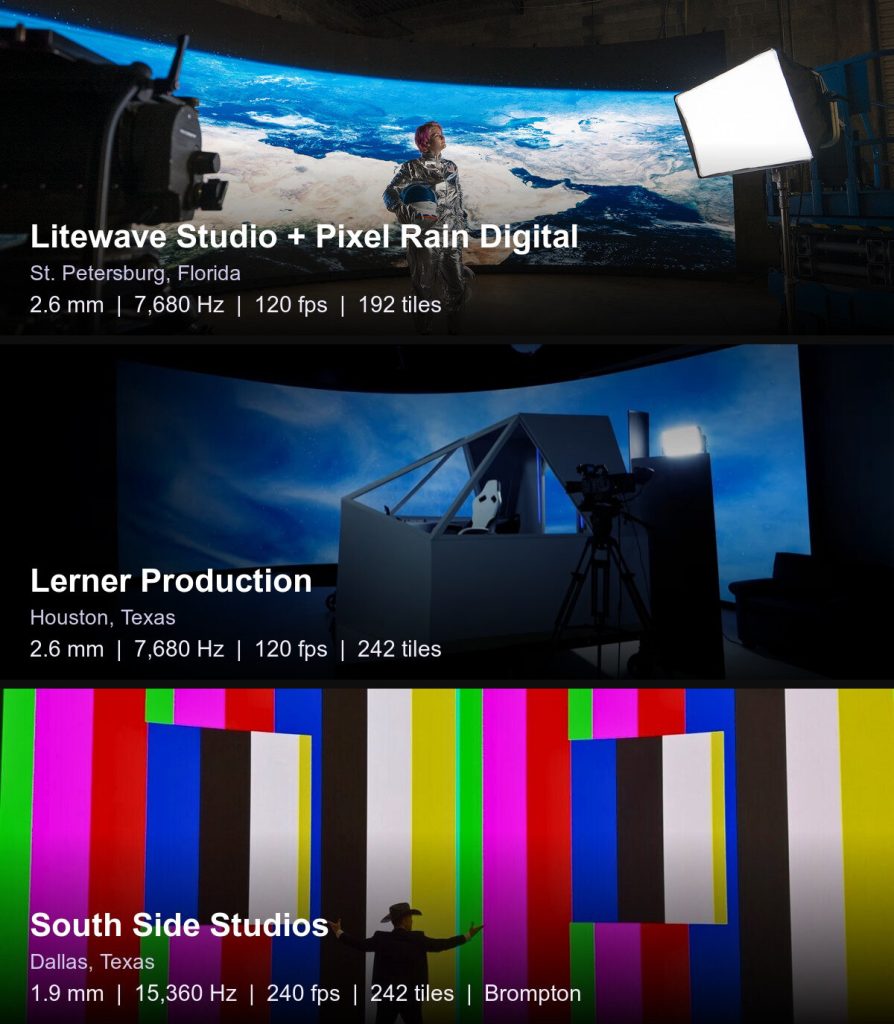
| Here are the specs of three virtual-production volumes HOLODECK LED built in the US: pixel pitch, refresh rate, frame rate and tile count. |
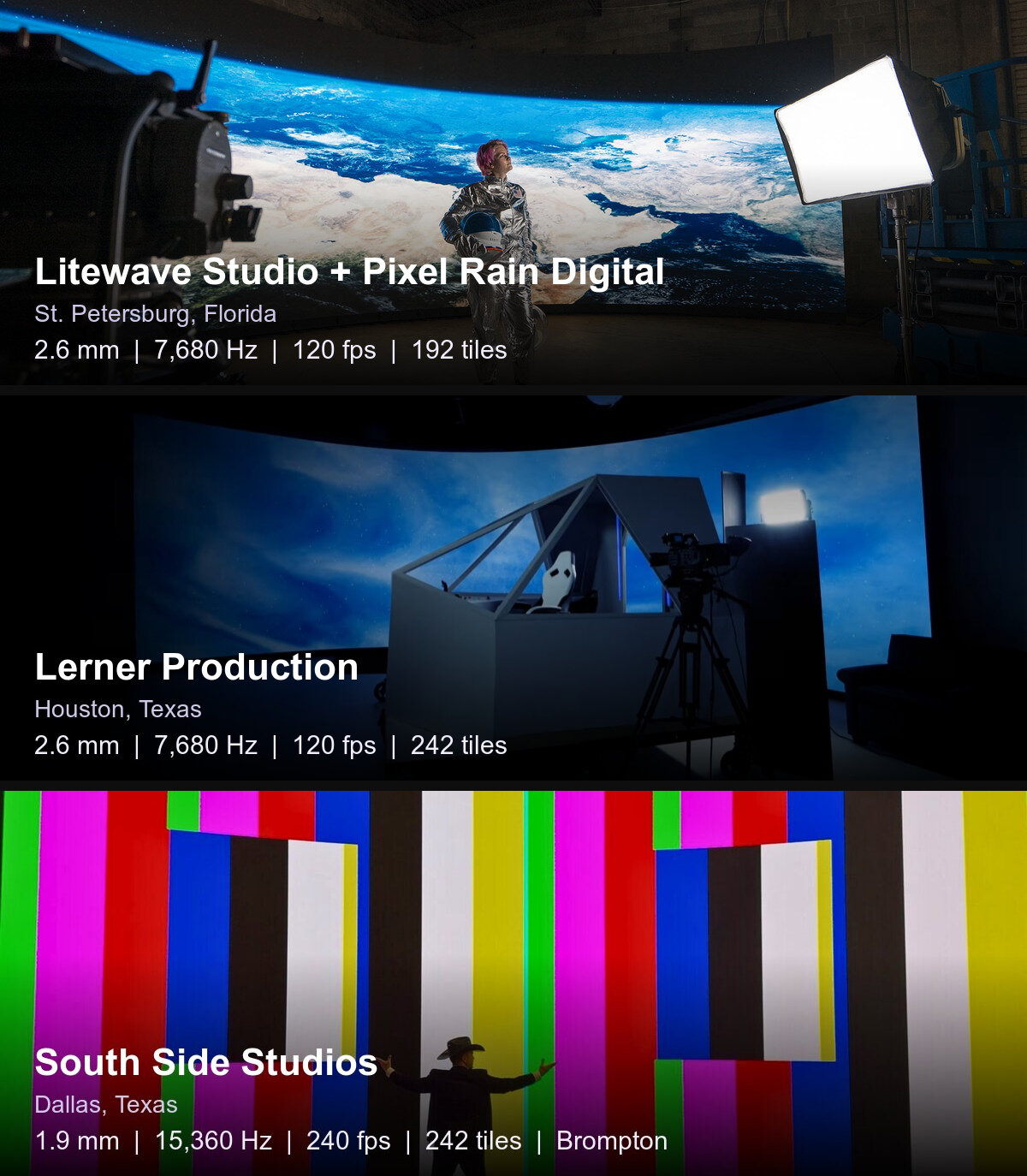 |
Litewave Studio + Pixel Rain Digital 2.6 mm pixel pitch · 7,680 Hz · 120 fps · 192 tiles
St. Petersburg, Florida Studio A at Litewave Media is a 60 ft by 60 ft stage with a 39 ft by 13 ft LED wall for virtual production. Pixel Rain Digital runs the virtual-production side: VIVE Mars camera tracking and real-time Unreal Engine content. |
| Lerner Production 2.6 mm pixel pitch · 7,680 Hz · 120 fps · 242 tiles
Houston, Texas Lerner Production’s Houston studio has a main wall of 40 ft by 12 ft, 651 sq ft in all. Lerner runs it alongside its film, video and live event production work. |
| South Side Studios 1.9 mm pixel pitch · 15,360 Hz · 240 fps · 242 tiles · Brompton
Dallas, Texas We built it with Talon Entertainment at South Side Studios, two miles from downtown Dallas: 70,000 sq ft of studio space on an 11-acre campus. The wall is a curved 36 ft by 18 ft volume with our Panta Black surface, run on Brompton Tessera SX40 processors. |
|
|
|
New Futures in Virtual Production: Keeping Reality at the Center |
At HOLODECK, we spend a great deal of time engineering virtual production technologies that help cinematographers, directors, and technicians create images that feel true to reality. |
That comes in all shapes and sizes. It can mean building a massive virtual production stage capable of creating an expansive cinematic world. Increasingly, it can also mean creating a smaller, agile stage and using virtual production and AI to make that compact physical environment feel almost limitless. |
From “Fix It in Post” to “Fix It in Pre” to “Fix It in Both” |
For years, filmmakers talked about “fixing it in post.” |
Virtual production began shifting that philosophy toward “fixing it in pre.” We could design environments, visualize the world, and make creative decisions earlier. |
Now we are entering another stage: “fix it in both.” |
We think about the image in pre. We design it. We light it correctly. We capture the performance and photography beautifully on set. Then, when something needs to change, emerging AI tools are making those adaptations increasingly powerful and efficient. |
The future isn’t purely pre-production, production, or post-production. It is a hybrid of all three. |
Keep the Human. Expand the World. |
At HOLODECK, we care deeply about keeping the human element at the center of the image. |
We want the director directing, the cinematographer shaping the light and choosing the lens, and the performers captured beautifully and authentically. |
What is changing dramatically is everything we can do around that human performance. |
AI can help expand backgrounds, extend environments, modify production design, and remove limitations imposed by the physical space. But there is an important distinction between asking AI to invent everything and using it to expand upon something that was intentionally photographed. |
When you begin with reality, with an actual performer, a real lens, intentional lighting, and filmmakers making creative decisions, you give these technologies something extraordinarily valuable to work from. |
The technology becomes an extension of the filmmaker rather than a replacement for the filmmaker. |
The Rise of Agile Virtual Production |
Not every production needs a massive permanent LED volume. |
Our plug-and-play virtual production technologies can move between stages and locations, allowing a smaller physical footprint to become the foundation for a much larger digital world. |
We see this particularly in car process work, where lighting, reflections, background plates, LED technology, camera tracking, and AI-assisted tools can work together to produce remarkably convincing results. That same thinking extends across cinema, commercials, sports, social media, robotics, education, and immersive storytelling. |
For us, the future of virtual production isn’t one particular technology. It is an expanding toolbox of LED, cameras, optics, lighting, tracking, robotics, real-time engines, production design, AI, visual effects, and classic filmmaking. |
The exciting part is not choosing between them. It is learning how to combine the best of each. |
At HOLODECK, that is where we believe the next generation of production is headed: capturing reality beautifully, expanding what is possible technologically, and keeping creative control in human hands. |
 | Paul Galando
Chief Experience & Innovation Officer |
|
|
|
| Photos and details of each install are on our Our Work page. |
| Questions? Write to connect3@holodeckled.com. |
HOLODECK LED™
57 Windward Ave, Venice, CA 90291 |