In the high-stakes world of corporate identity and luxury retail, the “Black Box” has always been the enemy. For decades, when an LED display was turned off—or even when it was displaying dark content—it looked like a massive, dusty grey rectangle. This was due to the physical limitations of SMD (Surface-Mounted Device) technology, which requires a relatively large plastic housing for every pixel.
But a revolution has arrived. As we push into ultra-fine resolutions below 1.5mm, the industry is moving toward MIP (MicroLED-in-Package). This technology doesn’t just offer more pixels; it offers better pixels. By merging the breathtaking contrast of MicroLED with the rugged reliability of a modular package, MIP has established itself as the definitive choice for the modern C-suite.
In this guide, we deconstruct the “MIP vs. SMD” debate and explain why MicroLED-in-Package is the key to unlocking the “Infinite Black” in your next landmark project.
1. Deconstructing the Pixel: SMD vs. MIP
To understand why MIP is superior, we have to look at the anatomy of the light source.
The SMD Legacy (Surface-Mounted Device)
SMD has been the workhorse of the industry for twenty years. It places three tiny LED chips (Red, Green, Blue) inside a single plastic “cup” or housing, which is then soldered to the board.
-
The Problem: The plastic housing takes up a lot of space. On a 1.2mm pitch screen, the “pixel” might occupy 60% of the surface area. This means 60% of your screen is actually grey plastic, which reflects ambient light and ruins your black levels.
The MIP Breakthrough (MicroLED-in-Package)
MIP is a hybrid technology. It uses “Micro-scale” LED chips—diodes so small they are nearly invisible to the naked eye—and places them into a microscopic package before mounting them on the board.
-
The Advantage: Because the chips are so small, the package can be much smaller. This leaves significantly more “empty space” on the board, which is filled with a deep-black resin.
2. The Science of the “Infinite Black”: Black Area Ratio (BAR)
The primary metric for image “depth” in a corporate lobby or boardroom is the Black Area Ratio (BAR). This is the percentage of the display surface that is non-reflective black material versus the area occupied by the LED lamps.
-
SMD Displays: Typically have a BAR of 30% to 50%. This results in a “greyish” appearance in bright lobbies.
-
MIP Displays: Often achieve a BAR of 80% to 95%.
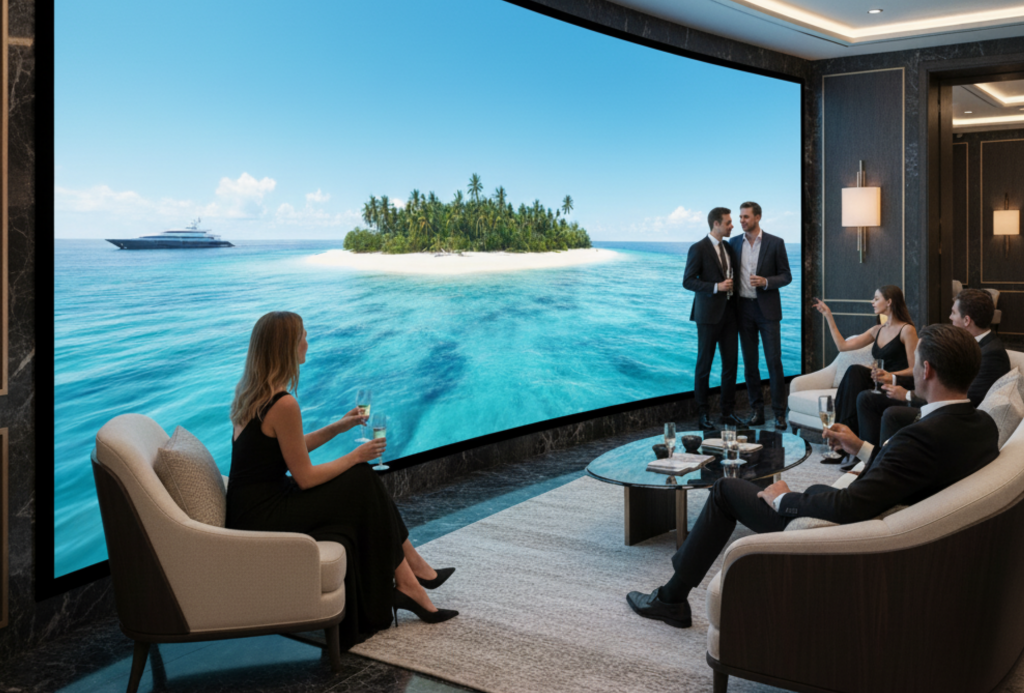
When you increase the black area by nearly double, the contrast ratio skydives into the millions. This is how the HoloGallery™ series achieves “Infinite Black”—where the screen seems to disappear into the wall when displaying dark content.
3. Durability: Making Fine-Pitch “Human-Proof”
In a high-traffic environment like a retail flagship or a shared corporate space, screens are subject to the “Touch Test.” Traditional fine-pitch SMD screens are notoriously fragile; a single accidental bump from a briefcase or a curious finger can “pop” a pixel off the board.
MIP technology solves this through “Micro-Encapsulation”:
-
Physical Resilience: The MIP package is shorter and has a wider “footprint” on the PCB, making it much harder to knock off.
-
Surface Protection: Most MIP displays, including our HoloGallery™ units, feature a specialized surface coating that makes them moisture-proof and dust-proof.
-
The “Cold” Advantage: MIP technology is more energy-efficient, meaning it generates less heat. Heat is the primary cause of the “pixel-dropping” seen in older SMD walls.
“In the boardroom, every decimal point matters. In the lobby, every reflection matters. MIP ensures that your data is sharp and your brand is prestigious, regardless of the lighting.”
4. The “MIP vs. COB” Debate: Why Repairability Wins
You may also hear about COB (Chip on Board) technology. While COB offers great contrast, it has a fatal flaw: it is nearly impossible to repair on-site. If a single pixel fails on a COB wall, you usually have to replace the entire module and send it back to a factory.
MIP offers the “Best of Both Worlds”:
-
You get the MicroLED performance and contrast of COB.
-
But because the pixels are still in individual “packages,” they can be repaired at the pixel level.
For a long-term investment like a Corporate Environment, the ability to perform a 5-minute on-site repair instead of a 2-week factory RMA is a massive operational advantage.
UPGRADE TO THE EXECUTIVE STANDARD
Don’t settle for “Grey” when you can have “Infinite Black.” Discover how MIP technology can redefine the visual authority of your workspace.
Consult with a HOLODECK MIP Expert Today
5. Applications: Where MIP Dominates
While MIP is a premium technology, the ROI is highest in specific scenarios:
-
Executive Boardrooms: Where high-brightness and perfect text legibility are required for data-driven decisions.
-
Luxury Retail: Where the “Digital Atmosphere” must match the quality of the high-end products on display (e.g., Rolls-Royce or Fred Segal).
-
Broadcast Newsrooms: Where the screen must be “Camera-Ready” and free of the glare that plagues larger SMD pixels.
Technical Performance Checklist
| Feature | Standard SMD | HOLODECK LED™ MIP |
| Contrast Ratio | 5,000:1 | 1,000,000:1 |
| Black Area Ratio (BAR) | ~40% | >85% |
| Viewing Angle | 140° | 170°+ |
| Surface Durability | Low (Fragile) | High (Encapsulated) |
| Energy Consumption | Standard | 30% Lower |
ACTIVATE YOUR LANDMARK
The era of the “Grey Wall” is over. Step into the light (and the dark) with the most advanced packaging technology in the industry.
Explore our HoloGallery™ Series
Engineering Prestige
The shift from SMD to MicroLED-in-Package (MIP) is more than a technical upgrade; it is a commitment to visual excellence. By mastering the relationship between package size, BAR, and physical durability, HOLODECK LED™ has provided the corporate and luxury worlds with a medium that finally matches their ambition.
In a world where everyone is fighting for attention, the most powerful statement you can make is one of absolute clarity and depth.