In the history of structural design, the transition from rigid, linear forms to organic, fluid shapes has always marked a leap in engineering capability. From the stone arches of Rome to the flowing steel of Zaha Hadid, the ability to “bend” materials has defined the most iconic landmarks of human history. Today, that same evolution is taking place in the digital realm. As architects seek to weave technology into the very fabric of their buildings, the traditional flat screen has become a creative limitation. To meet the demands of modern “Placemaking,” a new medium has emerged: the Flexible LED Display for Architecture.
At HOLODECK LED™, we recognized that the “sixth wall” and the curved pillar are just as valuable as the flat backdrop. This led to the development of the SoftFlex™ series—a high-resolution, magnetic, and ultra-pliable canvas designed to eliminate the 90-degree corner. By prioritizing physical versatility without sacrificing the cinematic performance of our “Creation” series, we have provided designers with the ultimate tool to turn static surfaces into living, breathing skins. In this guide, we explore the science of the curve and why a Flexible LED Display for Architecture is now a prerequisite for world-class luxury environments.
The 90-Degree Barrier to the Shift Toward Fluid Design
For decades, digital integration in buildings was an afterthought. Screens were “bolted on” to flat walls, creating a visual disconnect between the digital content and the physical space. However, modern architecture is increasingly defined by “Biophilic” design—the use of organic shapes that mimic the natural world. In a space characterized by circular atriums, winding corridors, and wave-like ceilings, a rectangular screen feels like a foreign object.
The shift toward a Flexible LED Display for Architecture allows the technology to follow the building’s lead.
-
Architectural Empathy: The screen wraps around columns or follows the sweep of a vaulted ceiling, ensuring the digital content feels native to the structure.
-
Immersive Continuity: By eliminating the “seams” of a faceted curve, flexible panels create a single, uninterrupted visual journey that draws the eye naturally through a space.
-
360-Degree Engagement: Whether it is a digital column in a luxury lobby or a circular “halo” display in a retail flagship, the curve ensures the brand message is visible from every possible vantage point.
The Physics of the SoftFlex™ Technology
What makes a Flexible LED Display for Architecture different from a standard panel is its foundational construction. To achieve a smooth arc without damaging the delicate light-emitting diodes, every component of the panel must be reimagined.
1. The Flexible PCB (Printed Circuit Board)
Standard LED panels use rigid glass-reinforced epoxy (FR4) for their circuit boards. If you bend them, they snap. The SoftFlex™ series utilizes a specialized polyimide or “Flex-PCB” substrate. This material can be bent, folded, and wrapped thousands of times without losing electrical integrity. This is the “spine” of the display, allowing it to conform to both convex and concave surfaces with ease.
2. Rubberized Pliable Masks
The “mask” is the plastic structure that sits over the LEDs to provide contrast and protection. In a rigid panel, this mask is stiff. In a Flexible LED Display for Architecture, the mask is made of a high-grade, UV-resistant rubber or silicone. This pliable mask ensures that as the panel bends, the distance between pixels (the pitch) remains constant, preventing “dark lines” or visual distortion in the curve.
3. Magnetic Floating Mounts
One of the greatest challenges of curved architecture is the mounting surface. No wall is perfectly smooth. The SoftFlex™ series utilizes a magnetic mounting system that allows the modules to “float” over a custom-fabricated metal frame. This ensures that every module is perfectly flush with its neighbor, creating a seamless digital skin regardless of the underlying structural imperfections.
BEND THE RULES OF DESIGN
Don’t let your architectural vision be limited by the flat world. Discover how HOLODECK LED™ can wrap your brand in light, turning any pillar, arch, or wave into a high-definition destination.
Consult with a SoftFlex™ Specialist Today
Case Study: The “Digital Sky” of the Coral Casino
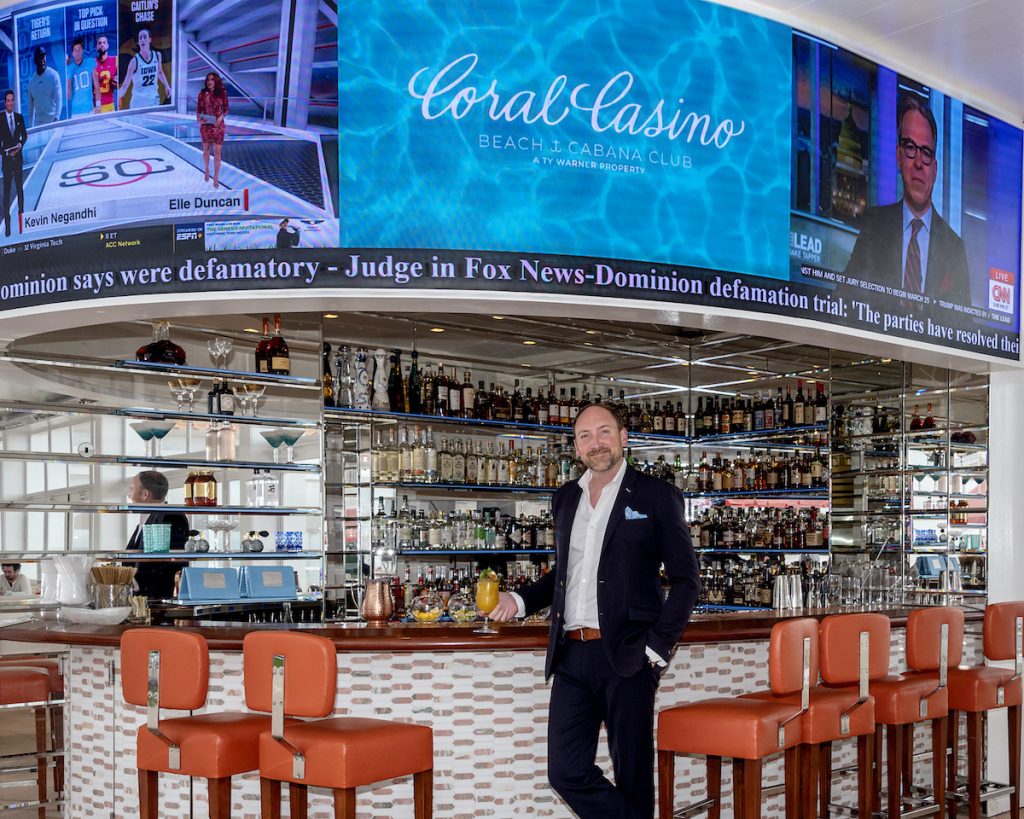
The power of a Flexible LED Display for Architecture is most evident in our work at the Coral Casino Beach & Cabana Club. When owner Ty Warner envisioned a 32-foot “digital sky” for the Coral Café, a standard screen was physically impossible. The interior architecture featured a sweeping convex curve that required a display that could bend without a single visible seam.
By utilizing the SoftFlex™ 1.5S, we were able to create a 32-foot arc that followed the ceiling’s line perfectly.
-
The 1.5mm Precision: Because members are dining just feet away from the display, the 1.5mm pixel pitch provides the “retina-level” detail required for photographic realism.
-
Atmospheric Integration: The screen doesn’t look like a TV; it looks like a glowing part of the building. It displays slow-moving sunsets and passing clouds, matching the mood of the Pacific Ocean just outside the windows.
-
The “Zero-Bezel” Effect: Because SoftFlex™ modules are magnetically joined, the 32-foot span appears as a single, continuous piece of digital glass.
Why “Soft” Doesn’t Mean “Low-Performance”
In the past, flexible displays were often relegated to low-resolution “ticker” applications because the technology couldn’t handle high refresh rates or color accuracy. The SoftFlex™ series has changed that, bringing the performance of our HoloDeck VP™ series to the architectural market.
1. 16-Bit High-Precision Grayscale
A Flexible LED Display for Architecture is often used in luxury environments where lighting is dim and sophisticated. At low brightness levels, standard screens often show “banding” in shadows. Our panels utilize 16-bit processing to provide 65,536 shades of color, ensuring that gradients—like the curve of a digital shadow or a sunset—are perfectly smooth.
2. High Refresh Rates (>3840Hz)
Whether it is for a high-end retail flagship or a corporate broadcast studio, the display must be “camera-ready.” With a refresh rate of 3,840Hz and beyond, SoftFlex™ ensures a flicker-free image on any smartphone or professional camera, preserving the brand’s prestige in every shared social media post.
3. DCI-P3 Color Compliance
Luxury brands require their specific “Heritage Colors” to be reproduced with 100% accuracy. Our flexible panels are calibrated to the DCI-P3 cinematic standard, ensuring that a brand’s digital skin looks exactly as the creative director intended.
ACTIVATE YOUR ARCHITECTURE
The era of the “bolt-on” screen is over. Join the world’s leading architects and integrate a responsive digital skin into your next landmark project.
Explore Our SoftFlex™ Product Portfolio
Creative Applications
The versatility of a Flexible LED Display for Architecture opens up a world of creative possibilities that extend far beyond the standard feature wall.
1. The Digital Column and “Wrap-Around” Pillar
In hospitality and retail, structural columns are often seen as “dead space.” By wrapping these pillars in SoftFlex™ technology, they become high-revenue advertising assets or dynamic art installations. A 360-degree digital column can show everything from a tropical forest to a cascading waterfall, transforming the lobby’s atmosphere instantly.
2. The “Ribbon” and Wave-Like Ceilings
For transit hubs or large convention centers, like the David L. Lawrence Convention Center, flexible LED ribbons can be used for wayfinding and branding. These “digital streams” can follow the path of the visitors, guiding them through the space with light and motion.
3. Concave “Immersive Tunnels”
In the world of Experiential Marketing, the “Tunnel” is a powerful tool for brand immersion. By using SoftFlex™ to create a 180-degree concave arc, brands can create a “portal” effect where the viewer is completely surrounded by the digital world. This is a favorite for high-end product launches and museum installations.
The ROI of Architectural LED
While the aesthetic benefits are undeniable, the investment in a Flexible LED Display for Architecture is a strategic move for property owners and developers.
-
Increased Real Estate Value: Buildings that feature unique, technologically advanced architecture command higher lease rates and higher occupancy levels. A digital landmark makes a building a destination.
-
Dynamic Content Agility: Unlike a physical sculpture or mural, an LED skin can be updated in seconds. A hotel can change its lobby’s theme for a wedding in the afternoon and a corporate gala in the evening, maximizing the utility of the space.
-
Sustainable Preservation: As seen in our Coral Casino project, using a lightweight, flexible LED system allows for the modernization of historic spaces without the need for destructive structural changes.
According to a report by Gensler, the future of urban design lies in “Responsive Environments”—spaces that use digital tools to react to the people within them. The Flexible LED Display for Architecture is the primary medium for this responsiveness.
Engineering the Fluid Future
The Flexible LED Display for Architecture has fundamentally changed the relationship between the digital and the physical. By mastering the engineering of the Flex-PCB, the magnetic floating mount, and the 16-bit color engine, HOLODECK LED™ has given the design community a new alphabet of light.
From the 32-foot digital sky of Montecito to the interactive pillars of global retail flagships, our mission remains the same: to provide the pixel-perfect canvas that turns a “structure” into a “landmark.” In a world where the customer is looking for a sense of wonder, the brands that win will be those that break the 90-degree grid and embrace the curve.
The future of architecture isn’t rigid; it is fluid, responsive, and rendered in light. Let’s build it together.