Why LED Broadcast Studio Solutions are Redefining Live Media
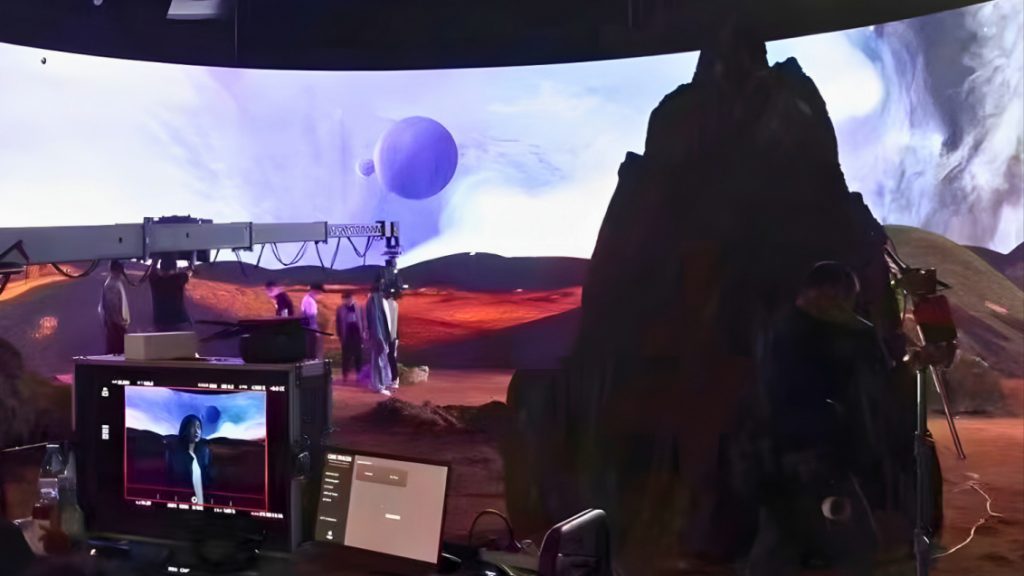
The modern newsroom is no longer a static background of plexiglass and printed graphics. It has evolved into a high-tech, responsive environment where information is as dynamic as the world it reports on. As viewers demand more immersive and data-driven content, networks are moving away from traditional sets and toward LED broadcast studio solutions that function as “digital windows” for the public.
For a broadcaster, the studio is the most important tool for building trust and engagement. Whether it is a breaking news alert, a weather update, or a deep-dive political analysis, the visual environment must be flawless. At HOLODECK LED™, we have spearheaded this transition, providing the technical engine for some of the most advanced newsrooms in the world. From the panoramic curves of CBS 8 in San Diego to the ultra-fine-pitch canvases of South Side Studio.
The Evolution of the News Desk: From Static to “Phygital”
To understand the rise of LED broadcast studio solutions, we must first look at the unique challenges of the broadcast environment. Unlike a cinema set, a news studio operates under “constant uptime” requirements. The screens must be perfectly calibrated for 24/7 operation, maintaining color consistency across thousands of hours of live airtime.
The move toward “Phygital” (physical + digital) spaces in broadcast means that the screen is no longer just “behind” the anchor; it is part of the architecture. It allows for:
-
Immersive Data Storytelling: Interactive maps and live data feeds that anchors can interact with in real-time.
-
Instant Rebranding: A single studio can be transformed from a bright morning talk show to a moody, high-contrast evening news set with the click of a button.
-
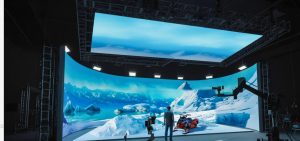
Panoramic Vistas: Curved arrays that wrap around the news desk, providing a cinematic field of view that makes the studio feel larger and more prestigious.
Case Study: CBS 8 KFMB (San Diego) – The Panoramic Digital Window
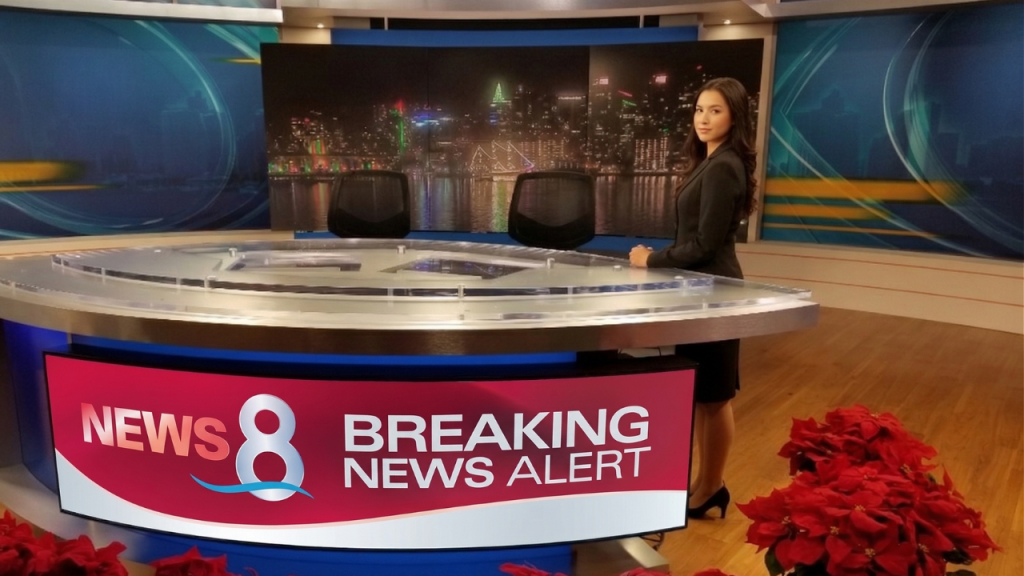
Our work with CBS 8 KFMB in San Diego stands as a premier example of how LED broadcast studio solutions can revitalize a regional news brand. The goal was to replace a traditional set with a panoramic “digital window” that could reflect the vibrant energy of the San Diego skyline.
The Integration: We installed a custom curved LED array that creates a seamless, wrap-around background for the news team.
Because broadcast cameras see light differently than the human eye, the pixel pitch and refresh rate were specifically calibrated. Utilizing a 2.5mm pitch, we ensured that the digital window remained sharp and lifelike even in wide-angle shots.
The news team can now transition from a live view of the harbor to a detailed weather map instantly. Providing a level of visual agility that was previously impossible.
Case Study: South Side Studio – Close-Proximity Precision
In broadcast, the “Moiré effect”—the wavy patterns that appear on screen when a camera gets too close—is the enemy of production. To solve this, the LED broadcast studio solutions at South Side Studio utilized an ultra-fine pitch approach.
-
By using a 1.9mm pixel pitch, South Side Studio created a LED wall that allows anchors to stand directly in front of the screen without digital artifacts appearing on camera.
-
This installation is optimized for high-definition news and data-driven programming, where fine text and detailed infographics must be legible to the viewer at home.
ELEVATE YOUR BROADCAST STANDARDS
Is your newsroom still relying on static backgrounds? It’s time to transition to a responsive, digital environment that captivates your audience. HOLODECK LED™ provides the engineering expertise to build the “digital windows” of tomorrow.
Explore Our Broadcast LED Solutions Today
The Technical Science: Why Refresh Rates and Grayscale Matter
To the average viewer, a screen is just a screen. But for a broadcast engineer, the success of LED broadcast studio solutions hinges on technical variables that are invisible to the naked eye but catastrophic on camera.
According to industry standards from AVIXA, the synchronization between the display and the camera is the most frequent point of failure in studio design.
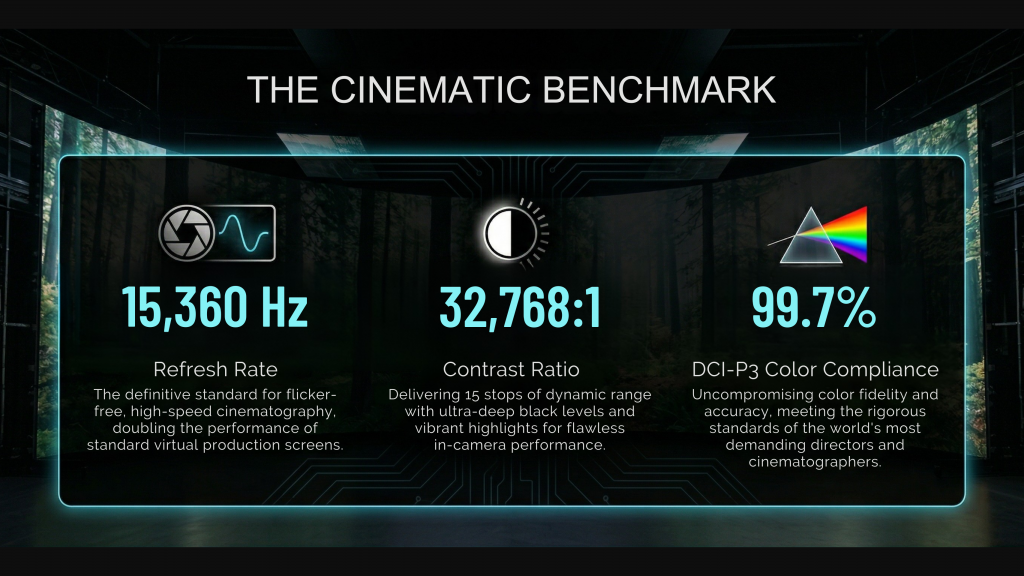
1. The 15,360Hz Refresh Rate
Standard screens often cause “flicker” on camera because their refresh rate doesn’t align with the camera’s shutter speed. HOLODECK™ broadcast-grade panels feature refresh rates of >15,360Hz. This ensures a rock-solid image that looks as stable on a 4K broadcast camera as it does in person.
2. 16-Bit High-Precision Grayscale
News sets often use intense theatrical lighting. If an LED wall has low bit-depth, the bright studio lights will cause “crushed blacks” or “blown-out whites” on screen. Our 16-bit grayscale provides over 65,000 steps of brightness, allowing for smooth gradients and perfect color reproduction under even the most demanding studio lights.
3. DCI-P3 Color Space Compliance
To ensure that a network’s brand colors—like a specific “News Red” or “Corporate Blue”—look identical on every TV in the country, the LED wall must meet cinematic color standards. HOLODECK™ panels offer 99.7% DCI-P3 compliance, providing the color accuracy required for professional television production.
Technical diagram of an LED panel showing front-serviceable modules for quick studio maintenance.
Maintenance in the Live Environment: The “No-Downtime” Rule
In a 24-hour news cycle, you cannot “turn off” the set for repairs. This is why the best LED broadcast studio solutions are built for rapid, tool-free maintenance.
Our panels feature Front and Rear Serviceable Modules. If a single module fails minutes before a live broadcast, a technician can swap it out in seconds using a magnetic tool, without having to dismantle the entire wall or disturb the anchors. This modularity is a critical insurance policy for networks that cannot afford a single minute of downtime.
JOIN THE NEWSROOM REVOLUTION
The landmarks of the future are being built inside the studio. Whether you are upgrading a regional newsroom or building a global broadcast hub, HOLODECK LED™ is your partner in engineering excellence.
Contact Our Broadcast Specialists for a Custom Quote
The Economics of Modern Broadcast Design
Beyond the visual impact, there is a clear financial incentive for adopting LED broadcast studio solutions.
-
Space Efficiency: Digital sets allow a single 2,000-square-foot studio to function as five different sets. This maximizes the utility of expensive real estate in cities like New York, London, or San Diego.
-
Once the LED “skeleton” is in place, you no longer need to pay for physical set builds, storage, or strike crews every time a show is updated.
-
Networks with multiple locations can push the same digital “skin” to every studio globally, ensuring that their brand looks identical whether the broadcast is coming from Dallas, Chongqing, or Beijing.
Designing for the “Digital Window” Future
As we look toward the future, the integration of Augmented Reality (AR) and VR will become the standard. We are already seeing “Extended Reality” (XR) workflows where the LED wall and AR elements merge, allowing weather forecasters to stand “inside” a digital hurricane or analysts to walk through a 3D model of a new architectural project.
At HOLODECK LED™, we aren’t just selling pixels; we are providing the infrastructure for this phygital future. The Creation Series—including SMT XR Lab and DXG Studio—proves that when you master the screen, you master the world.
Engineering the Authority
In the era of information, the environment where that information is delivered matters. By investing in high-performance LED broadcast studio solutions, networks are doing more than just buying technology; they are investing in their own authority.
From the ultra-fine 1.9mm pitch HOLODECK VP™, required for close-proximity interviews, to the massive, curved panoramas that define a modern news brand, our broadcast grade LED panels are the canvas for the world’s stories. As the broadcast industry continues to evolve, we remain dedicated to providing the flicker-free, color-accurate, and mechanically perfect foundations that live media demands.
The future of news isn’t just about what is said—it’s about how it’s seen.